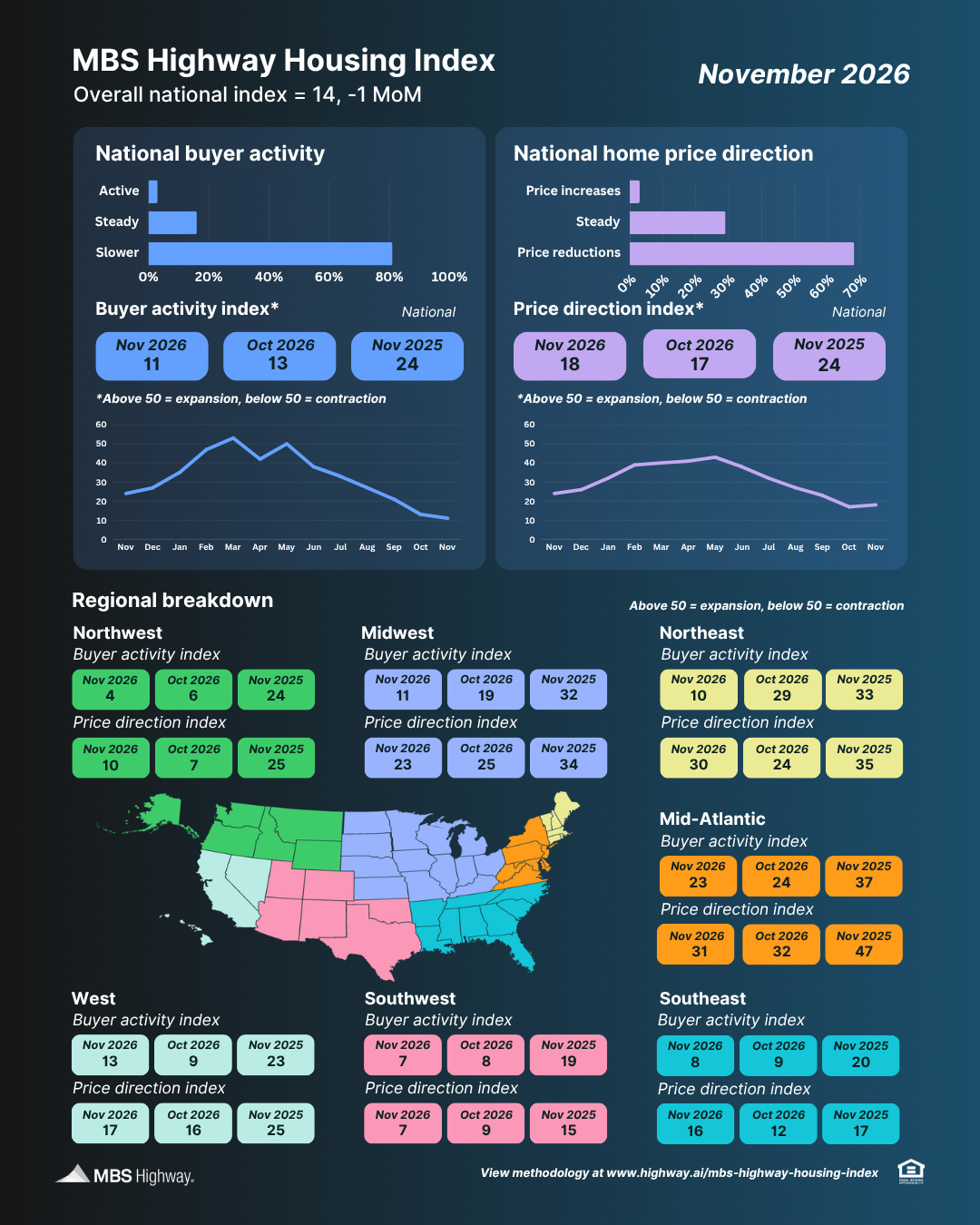
The MBS Highway National Housing Index slipped to 14 in November, down from 15 in October, marking its sixth straight monthly decline. Buyer activity continued to weaken, while the price direction index posted a modest one-point rebound after declining every month since May.
National Data
The MBS Highway National Housing Index fell one point to 14 in November, its lowest level in four years. The index is also 10 points below where it stood a year ago. Readings above 50 indicate expansion, while those below 50 signal contraction. November's reading confirms that housing market activity remains firmly in contraction territory.
The buyer activity index dropped two points to 11, compared with 24 a year ago, when mortgage rates were lower. Nationwide, 81% of respondents reported slower buyer activity, continuing a trend of weakening demand. The results suggest that elevated mortgage rates are still weighing on homebuyer activity.
The price direction index edged up one point to 18 after five consecutive monthly declines. However, with the index still well below 50, price reductions continue to outpace price increases across the country.
Regional Data
Buyer activity declined in six of the seven regions, with the steepest drops in the Northeast (down 19 points to 10) and Midwest (down 8 points to 11). The Mid-Atlantic had the strongest reading at 23, though every region remained below the 50-point expansion threshold.
Price direction improved in four of the seven regions, although most gains were modest. The Northeast posted the largest increase, rising six points to 30. The Mid-Atlantic had the strongest price direction reading at 31.
Question of the Month
With higher mortgage rates continuing to weigh on home sales, we asked respondents how they expect existing home sales to trend in 2027. They could choose from three options:
· More bullish: Expect existing home sales to rise
· More bearish: Expect existing home sales to fall
· About the same: Expect transaction volumes to remain relatively flat
Half of respondents (50%) expect transaction volumes to remain about the same in 2027. The other half were evenly split, with 25% anticipating an increase in sales and 25% expecting a decline.
The expectation for sales to remain relatively flat was the most popular choice in all seven regions. Beyond that, regional outlooks varied. The Midwest was the most confident about a stable market, with 60% expecting little change, while the Mid-Atlantic had the most evenly divided outlook, with 32% anticipating an increase and 32% expecting a decline. The Northwest was the most bearish, with 33% expecting sales to fall, while the Southeast was somewhat more bullish, with 28% expecting an increase.